
How to choose a core cutter: a buyer’s guide for paper and plastic cores
A core cutter — or paper core cutter — is chosen from your cores, not from a brochure. Six figures decide the machine; the cutting method and the level of automation follow from them.
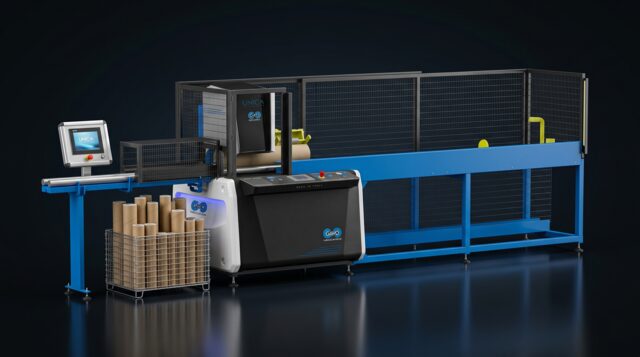
In short: measure your cores first — inside diameter, wall thickness, material, mother-tube length, widths and tolerance, volumes. Board is cut with a knife or a saw, rigid PVC with a saw, PP and PE on a lathe. A manual cutter suits low volumes, a semi-automatic one takes over when cutting fills a large part of a shift, and an automatic CNC machine pays off when the width changes many times a day.
1. The data that decide
Collect these figures before you ask for a price. They point to the right cutting method and machine family, and they are the same figures a supplier needs to quote.
| Data | Why it matters | What to check |
|---|---|---|
| Inside diameter | Knife and lathe cut on a support mandrel that must match the inside diameter. | The range the machine accepts. Converters mostly run 3" (76 mm) and 6" (152 mm) cores. |
| Wall thickness | It limits the method: on board, a knife usually cuts walls up to 20 mm, 25 mm on some machines. | Your thickest wall against the stated maximum, for board and for plastic. |
| Material | Board, rigid PVC, PP and PE do not behave the same way under the tool. | That the machine cuts every material you use, and with which tooling. |
| Mother-tube length | Mother tubes are typically 3 to 6 m long; every machine has a maximum loading length. | That the tubes you buy fit the machine, or that your tube supplier can deliver a length that does. |
| Widths and tolerance | The shortest core and the tolerance you need narrow down the machine family. | The minimum cut length and the length tolerance stated by the builder. |
| Volumes and format changes | They decide between manual, semi-automatic and automatic. | Cores cut per day or per week, and how many times a day the width changes. |
2. Saw, knife or lathe
The cutting method decides dust, edge quality and material loss. Dust and burrs end up on the film; the edge decides how the core sits on the winding shaft.
| Circular saw | Rotary knife | Lathe | |
|---|---|---|---|
| How it cuts | removes material | scores and presses | tool on the spinning core |
| Dust | high | almost none | low |
| Edge | square | slightly crushed | clean, can be deburred |
| Walls (board) | all, including thick | usually up to 20 mm, 25 mm on some machines | all |
| Material lost | 1–3 mm per cut | none | the width of the tool |
| Typical accuracy (automatic machines; saw and lathe: estimates) | ±0.2–0.5 mm | ±0.1–0.3 mm | ±0.1 mm |
| Suited to | PVC, thick walls, many sizes | board, clean areas | PP, PE, precision |
Source: papercores.info, ROLL Lab cutting guide.
- Board: knife or saw; beyond a 15–20 mm wall, or with very hard walls, saw or lathe.
- Plastic: rigid PVC with a saw; PP and PE on a lathe, because under a saw they tend to melt and leave burrs.
- Clean areas (food, pharma, print): saw dust must be well extracted, or choose the knife.
Two defects to look for on sample cuts: internal burrs left by a saw, which can snag on the shaft lugs or chucks and must be removed; and an inward lip on knife-cut board, usually caused by a worn blade, too fast a feed or a support mandrel smaller than the inside diameter. The three methods are compared in detail in the core cutting guide on papercores.info.
3. Manual, semi-automatic or automatic
Volumes and format changes set the level of automation. With low volumes and occasional formats, a manual cutter is enough. When an operator spends a large part of the shift cutting cores, a semi-automatic machine gives that time back. When the width changes many times a day, an automatic CNC machine with automatic loading plans the cutting sequence over each mother tube and leaves the operator only the loading.
The three GAVO Meccanica families on CORES WORLD all take mother tubes up to 2,000, 3,000 or 4,000 mm long. They differ in the shortest core they cut and in what the operator does:
| Family | Example model | Max mother-tube length | Min. cut length | Operator |
|---|---|---|---|---|
| Automatic | TCRG | 2,000 / 3,000 / 4,000 mm | 20 mm | loads tubes, the CNC plans and cuts |
| Semi-automatic | UNICA PLUS | 2,000 / 3,000 / 4,000 mm | under 5 mm | loads and starts each tube |
| Manual | TCEG | 2,000 / 3,000 / 4,000 mm | 80 mm | positions every cut |
Data from the GA.VO. Meccanica catalogue. Other models cover larger diameters and minimum cuts down to 7 mm.
Accuracy follows the same line. Builders state ±0.1 to ±0.5 mm on automatic machines; on manual ones accuracy depends on the operator, in practice ±0.5–1 mm. Asking for a tighter tolerance than your winding needs raises the price with no benefit.
4. Safety
A core cutter is a machine with rotating tools: look for fixed guards, interlocked movable guards, an emergency stop and dust extraction. At the design stage the references are EN ISO 12100 for risk assessment and, from 20 January 2027, the Machinery Regulation (EU) 2023/1230, which replaces Directive 2006/42/EC. Use in the workplace falls under national health and safety law (in Italy, Legislative Decree 81/2008). If you buy a used machine, check the CE marking, the declaration of conformity and the guards.
5. Questions to ask the supplier
- Which inside diameters and wall thicknesses does the machine accept, and which mandrel or tooling does each size need?
- Which cutting method does it use, and does it cut plastic cores as well as board?
- What is the maximum mother-tube length, and the shortest core it cuts?
- What length tolerance do you state, and on which cores was it measured?
- How long does a width change take, and what happens to the stub left at the end of each mother tube?
- Is dust extraction included? Will the cut cores need deburring?
- Which documents come with the machine: CE marking, declaration of conformity, description of the guards and emergency stop?
- Can you cut samples from our own mother tubes before we order?
- What floor space, power supply, spare tools and service should we plan for?
When the first cores come off the machine, check the length on at least nine pieces per pallet (three at the bottom, three in the middle, three at the top), use a calliper or a reference bar for tolerances below ±0.5 mm, and make sure the end is square and does not hinder loading onto the shaft.
6. When does cutting in-house pay off?
Cutting in-house replaces dozens of pre-cut sizes with one stock item: the mother tube. The payback comes from four items: the price gap between mother tubes and pre-cut cores, the freight saved, the stock you no longer hold in every width and the offcuts you eliminate. If you buy a few sizes in steady volumes, pre-cut cores from your tube supplier may well be enough. The calculation is explained on the core cutting machines page; send your volumes through the RFQ page and ROLL routes them to GAVO Meccanica.
Frequently asked questions
What is a core cutter?
A machine that cuts paper or plastic cores to length from long mother tubes, so that each core matches the width of the reel to be wound. It is also called a paper core cutter or core cutting machine.
Saw or knife for cutting paper cores?
A rotary knife makes no dust and loses no material; on board it usually cuts walls up to 20 mm, 25 mm on some machines. A saw cuts any wall but makes dust, loses 1–3 mm per cut and leaves internal burrs to remove.
What length tolerance can a core cutter hold?
Builders state ±0.1 to ±0.5 mm on automatic machines. On manual ones accuracy depends on the operator: in practice ±0.5–1 mm.
Can one machine cut paper and plastic cores?
Many machines can, with the same tool or a quick change. On plastic the stated maximum wall is lower, about 11 mm against 15–20 mm for board; PP and PE cut better on a lathe, rigid PVC with a saw.
Manual or automatic core cutter: how do I decide?
From the cores you cut per day and how often the width changes: manual for low volumes and occasional formats, semi-automatic when cutting takes up a large part of a shift, automatic CNC when the width changes many times a day.
Tell us about your cores and your rolls.
Send us your core dimensions, materials and yearly volumes. ROLL replies within 24 hours with the right solution — or the right partner in the ecosystem.
Request a quote See the RFQ guide
Write to us directly — info@roll-packaging.com